

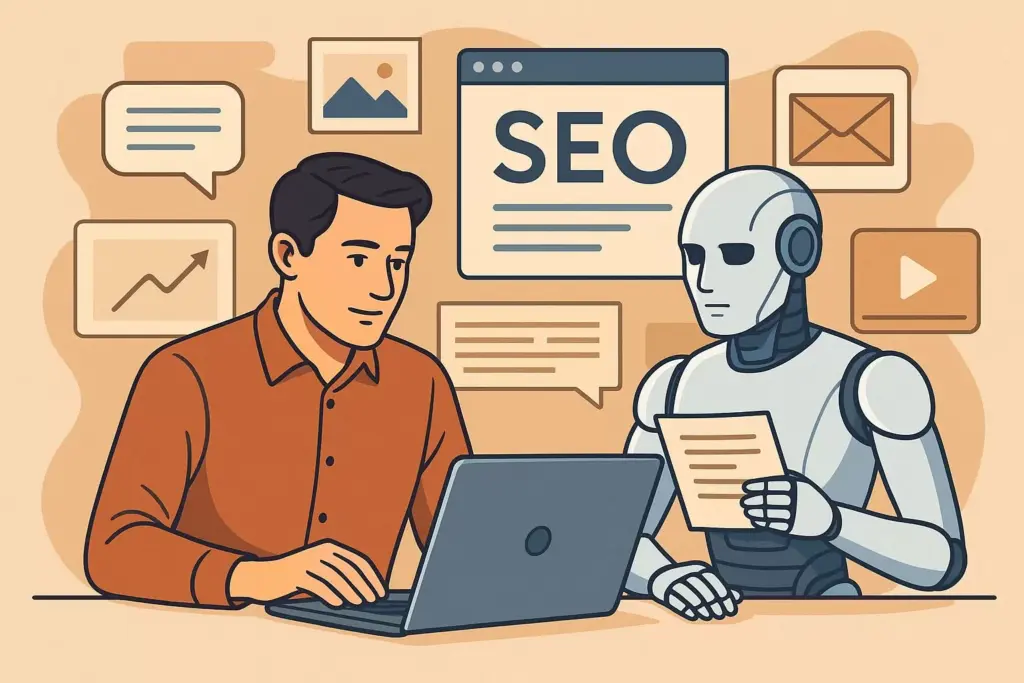
You are sitting at your desk, staring at a blinking cursor, feeling the familiar pressure of an upcoming content deadline. Maybe you have a list of fifty blog post ideas that need to be turned into full-length articles by next week, or perhaps you are wondering if the hours you spend researching, interviewing experts, and crafting nuanced sentences are still worth it in an era where a chatbot can generate a two-thousand-word guide in thirty seconds. This is the dilemma facing every marketer, business owner, and content creator today. The rise of artificial intelligence has shaken the foundations of search engine optimization, leaving many to question whether the human touch is becoming obsolete or if it is more valuable than ever before. The internet is flooded with conflicting advice, with some gurus claiming that AI is the ultimate shortcut to ranking dominance while others insist that only human-written content can survive Google’s latest algorithm updates. The truth, as is often the case, lies somewhere in the messy middle, requiring a deep dive into how search engines actually evaluate quality, relevance, and authority. To understand what truly performs better in SEO, we must move beyond the hype and examine the mechanics of how both AI-generated content and human content interact with the complex ecosystem of modern search results.
Understanding the Core Differences Between Machine and Mind
To make an informed decision about your content strategy, you first need to understand the fundamental differences in how artificial intelligence and human beings create text. AI models, particularly large language models, operate on probability and pattern recognition. They have ingested vast amounts of data from the internet and learned to predict which word is most likely to come next in a sentence based on the context provided. When you ask an AI to write an article, it is not “thinking” in the way humans do; it is assembling pieces of information it has seen before to construct a coherent response that mimics human writing styles. This allows for incredible speed and consistency, enabling the production of massive volumes of content without fatigue. However, this reliance on existing patterns means that AI often struggles with true originality, deep emotional resonance, or breaking new ground on a topic it has not seen extensively in its training data. It tends to summarize common knowledge rather than offer unique insights, and it can occasionally hallucinate facts, presenting incorrect information with unwavering confidence because its goal is linguistic fluency, not factual verification.
In contrast, human content creation is driven by experience, emotion, critical thinking, and the ability to synthesize disparate ideas into something genuinely new. A human writer draws upon their personal history, professional expertise, and intuitive understanding of audience pain points to craft a narrative that connects on a deeper level. When a human writes, they are making conscious choices about tone, structure, and emphasis based on a specific strategic goal and an empathetic understanding of the reader’s state of mind. Humans can conduct original research, interview subject matter experts, test products firsthand, and offer opinions that challenge the status quo. This capacity for lived experience is what allows human writers to inject personality and authority into their work in ways that algorithms currently cannot replicate. While a machine can describe the taste of a lemon based on thousands of descriptions it has read, only a human can convey the specific memory of biting into a sour lemon on a hot summer day and the visceral reaction that follows. This distinction is crucial for SEO because search engines are increasingly designed to reward content that demonstrates real-world expertise and authentic connection.
How Google Evaluates Content Quality in the Age of AI
The central question for any SEO practitioner is how search engines, particularly Google, distinguish between these two types of content and which one they prefer. For years, there was a misconception that Google penalized AI content simply because it was automated. However, Google has explicitly stated multiple times that their ranking systems focus on the quality of the content, not the method of its creation. Their primary goal is to serve users the most helpful, reliable, and relevant information possible, regardless of whether a human or a machine wrote it. This shift in perspective means that the debate is no longer about banning AI but about meeting the rigorous standards of quality that Google’s algorithms enforce. The key framework here is E-E-A-T, which stands for Experience, Expertise, Authoritativeness, and Trustworthiness. These four pillars act as the litmus test for high-performing content in competitive search landscapes.
Experience is the newest and perhaps most critical addition to this framework, referring to the extent to which the content creator has firsthand life experience with the topic. Google wants to see evidence that the author has actually used the product, visited the location, or lived through the situation they are describing. This is inherently difficult for AI to fake convincingly over the long term, as AI lacks physical presence and personal history. Expertise refers to the depth of knowledge the creator possesses, often demonstrated through credentials, a portfolio of work, or detailed technical accuracy. Authoritativeness is about the reputation of the website and the author within their specific niche, often signaled by backlinks from other reputable sites and mentions in industry circles. Finally, Trustworthiness encompasses the accuracy of the information, the transparency of the sourcing, and the security of the website itself. When Google’s algorithms crawl a page, they are looking for signals that satisfy these criteria. Content that is thin, generic, or riddled with inaccuracies will struggle to rank, whether it was written by a tired intern or a sophisticated bot. Conversely, content that offers unique value, cites credible sources, and demonstrates deep understanding will perform well, even if AI tools were used to assist in the drafting process.
The Strengths and Weaknesses of AI-Generated Content for SEO
Artificial intelligence brings undeniable advantages to the table, particularly when it comes to efficiency and scalability. One of the strongest use cases for AI in SEO is the ability to generate content outlines, brainstorm headline variations, and produce draft versions of articles at a pace that no human team could match. For topics that are factual, straightforward, and do not require deep opinion or personal anecdote, such as defining technical terms, summarizing news events, or creating basic how-to guides, AI can produce competent content very quickly. This allows businesses to cover a wide breadth of keywords and maintain a consistent publishing schedule, which are both positive signals for search engines. Furthermore, AI is excellent at structural tasks, such as ensuring proper header hierarchy, integrating keywords naturally, and formatting content for readability. It can also help non-native speakers refine their grammar and flow, making content more accessible to a global audience. In programmatic SEO strategies, where thousands of landing pages are needed for different locations or product variations, AI is often the only viable tool to generate the base content required to get those pages indexed.
However, the weaknesses of AI-generated content become glaringly apparent when you move beyond surface-level information. The most significant issue is the tendency toward mediocrity and homogenization. Because AI models are trained on existing internet data, they often regurgitate the same common knowledge found in the top ten search results, resulting in content that feels repetitive and lacks a unique voice. This creates a phenomenon known as “content convergence,” where hundreds of articles say the exact same thing in slightly different words, offering no new value to the reader. Search engines are getting better at identifying and devaluing this type of derivative content. Another major weakness is the lack of genuine insight or contrarian viewpoints. AI is designed to be safe and agreeable, so it rarely takes a bold stance or challenges conventional wisdom, which are often the elements that make content go viral or earn high-quality backlinks. Additionally, AI struggles with current events unless it has access to real-time browsing tools, and even then, it may miss the nuance of a developing story. There is also the persistent risk of hallucinations, where the AI confidently states false statistics, invents case studies, or cites non-existent sources, which can severely damage a site’s trustworthiness and lead to penalties if not caught during editing.
Why Human Touch Remains the Ultimate SEO Advantage
Despite the rapid advancements in artificial intelligence, the human element remains the single most powerful differentiator in high-stakes SEO environments. The primary reason for this is the ability of humans to provide the “Experience” component of E-E-A-T in a way that is authentic and verifiable. When a reader encounters an article that includes personal stories, specific details about a user journey, or photos taken by the author, they immediately perceive higher value and credibility. Search engines are increasingly using user behavior metrics, such as time on page, bounce rate, and return visits, as proxies for quality. Human-written content that resonates emotionally tends to keep readers engaged longer, encouraging them to scroll deeper, click on internal links, and share the content on social media. These engagement signals tell Google that the content is satisfying user intent, which boosts rankings. A human writer can also navigate complex ethical considerations and sensitive topics with a level of empathy and judgment that AI currently lacks, ensuring that the tone is appropriate for the specific audience and context.
Moreover, human creators excel at synthesizing information from diverse sources to create novel frameworks and original research. While AI can summarize what has already been said, humans can conduct surveys, run experiments, analyze proprietary data, and draw conclusions that have never been published before. This type of original contribution is the holy grail of link building, as other websites are far more likely to reference and link to unique data points and fresh perspectives than to a rehashed summary of common knowledge. In industries like health, finance, and law, where the stakes of misinformation are high, the requirement for verified human expertise is non-negotiable. Google’s algorithms are particularly strict with Your Money or Your Life (YMYL) topics, and content in these niches almost always requires a named author with recognized credentials to rank well. Even in less critical niches, the personality and brand voice that a human writer infuses into the text help build a loyal community around a website. Readers return to sites because they connect with the author’s voice and perspective, creating a sustainable traffic source that is resistant to algorithm fluctuations. This relationship building is a long-term SEO asset that purely automated content strategies fail to cultivate.
Strategic Integration: Building a Hybrid Workflow for Maximum Impact
The most effective SEO strategy in the current landscape is not to choose between AI and human content but to integrate them into a synergistic workflow that leverages the strengths of both. This hybrid approach acknowledges that AI is a powerful tool for augmentation rather than a replacement for human intellect. A practical way to implement this is to use AI for the heavy lifting of research and structuring while reserving human effort for insight, storytelling, and final polishing. For instance, a content team might use AI to analyze top-ranking competitors, identify content gaps, and generate a comprehensive outline that covers all necessary subtopics. The AI can then draft the initial version of the article, ensuring that all technical SEO requirements like keyword placement and meta descriptions are met. At this stage, the human editor steps in to transform the draft. They will inject personal anecdotes, verify all facts and statistics, replace generic examples with specific case studies, and rewrite sections to match the brand’s unique voice. This process significantly reduces the time spent on the blank page while ensuring the final output meets the high standards of E-E-A-T.
Another effective tactic is using AI to handle the scaling of informational content while dedicating human resources to pillar pages and cornerstone content. Informational queries that seek simple definitions or quick answers can often be satisfied with AI-assisted content that has been rigorously fact-checked. This frees up expert writers to focus on deep-dive guides, opinion pieces, and investigative reports that require high levels of expertise and original thought. These high-value pieces serve as the authority anchors for the website, attracting backlinks and establishing domain credibility, which in turn lifts the rankings of the simpler, AI-assisted pages. It is also crucial to establish a robust editorial guideline that mandates human review for every piece of content before publication. This review process should specifically look for signs of AI hallucination, check for emotional resonance, and ensure that the content offers a unique angle. By treating AI as a junior researcher or a first-draft writer and positioning the human as the senior editor and strategist, organizations can achieve both the scale needed to compete in modern SEO and the quality required to win user trust.
Common Misconceptions and Myths About AI Content Ranking
There are several pervasive myths surrounding AI content and SEO that can lead marketers astray if they are not addressed with clarity. One of the most common misconceptions is the belief that Google can instantly detect and penalize any content created by AI. While Google has developed sophisticated tools to identify patterns associated with machine generation, their official stance is that they do not penalize content solely based on its origin. The penalty comes from low quality, spammy behavior, or a lack of value, not the tool used to create it. If an AI-generated article is well-researched, accurate, and helpful, it has the same potential to rank as a human-written one. Conversely, poorly written human content will still fail to rank. The focus should always be on the output quality, not the input method. Another myth is that AI content is inherently cheaper and therefore better for ROI. While the upfront cost of generating AI text is low, the hidden costs of editing, fact-checking, and fixing reputational damage from errors can quickly add up. Furthermore, if the content fails to engage users or earn links due to its generic nature, the investment yields little return in terms of organic growth.
Some also believe that adding a disclaimer stating that content was AI-generated will boost rankings or protect against penalties. In reality, transparency is good for trust, but Google does not give ranking bonuses for disclosing the use of AI. The priority for search engines is whether the content satisfies the user’s query, not the provenance of the text. Another dangerous misconception is that AI can fully automate a link-building strategy by generating guest posts at scale. This approach often leads to low-quality backlinks from irrelevant sites, which can trigger manual actions or algorithmic filters that harm the entire domain’s visibility. Link building requires relationship building and high-quality content creation, areas where human nuance is indispensable. Finally, there is the myth that AI will eventually render human writers obsolete in SEO. As AI becomes more prevalent, the baseline for acceptable content rises, making generic information a commodity. This actually increases the value of distinctively human traits like creativity, empathy, and strategic thinking. Rather than replacing humans, AI is raising the bar, forcing creators to push beyond summary and into the realm of genuine insight and connection.
Practical Steps to Audit and Optimize Your Current Content Strategy
If you are unsure where your current content stands in relation to these new dynamics, conducting a thorough audit is the best first step. Begin by categorizing your existing content library into three buckets: high-performing evergreen content, underperforming informational pieces, and outdated or thin content. For your high-performing articles, analyze what makes them successful. Is it the depth of research, the inclusion of original data, or the engaging narrative style? Ensure that these elements are preserved and enhanced, regardless of whether you use AI to help update them. For underperforming pieces, determine if the issue is a lack of depth, poor structure, or outdated information. This is an ideal opportunity to apply the hybrid model. Use AI to expand on shallow sections, suggest new subheadings based on current search trends, and improve readability, but have a human expert rewrite the introduction and conclusion to add personality and verify the new information. For thin or outdated content, decide whether it is worth revamping or if it should be consolidated into a more comprehensive guide or removed entirely to prevent diluting your site’s overall quality.
When creating new content, implement a checklist based on E-E-A-T principles before hitting publish. Ask yourself if the article demonstrates first-hand experience, if the claims are backed by credible sources, and if the author’s bio clearly establishes their expertise. If you have used AI in the creation process, be prepared to answer the question, “What unique value does this add that isn’t already available in the top five search results?” If the answer is vague, the content needs more human intervention. Invest in training your team on how to use AI prompts effectively to get better drafts, but emphasize that the prompt is just the beginning of the process, not the end. Encourage writers to view AI as a collaborator that handles the mundane tasks, freeing them to focus on high-level strategy and creative expression. Regularly monitor your analytics for changes in user engagement metrics. If you notice a drop in time on page or an increase in bounce rate after shifting to more AI-heavy production, it may be a signal that the content is losing its human connection. Be willing to pivot and reintroduce more human-led storytelling if the data suggests that your audience is craving authenticity.
Future Outlook: The Evolving Relationship Between Search and Creation
Looking ahead, the relationship between search engines, AI, and human creators will continue to evolve in fascinating ways. As AI models become more advanced, the gap in writing quality between machines and humans will narrow, making the differentiation based on style and grammar less relevant. The battleground for SEO will shift almost entirely to the realms of trust, originality, and multimedia integration. We can expect search engines to place even greater emphasis on verifying the identity and reputation of content creators, potentially through digital signatures or verified author profiles that confirm human involvement. The concept of “information gain” will become paramount, where algorithms specifically reward content that adds new knowledge to the web rather than just rearranging existing information. This means that the role of the human writer will transition from being a producer of words to being a curator of truth and a generator of unique insights. Video, audio, and interactive elements will also play a larger role, as these formats are inherently more difficult for AI to replicate with the same level of authenticity as text.
Furthermore, the rise of AI-generated search summaries, such as Google’s AI Overviews, will change how users consume information. Users may get direct answers to simple questions without clicking through to websites, which means that content creators must focus on answering complex, nuanced questions that require deep dives and expert analysis. The value of a website will lie in its ability to provide the context, the “why,” and the “how” that a brief AI summary cannot capture. This environment favors brands that build strong communities and loyal followings, as direct traffic and brand searches will become more insulated from algorithmic volatility. The future of SEO is not about tricking a bot with keywords or churning out thousands of mediocre articles; it is about building a digital destination that offers genuine value, fosters trust, and provides a human connection in an increasingly automated world. Those who embrace AI as a tool to enhance their human capabilities, rather than replace them, will be the ones who thrive in this new era.
Final Thoughts on Balancing Efficiency and Authenticity
The question of whether AI-generated content or human content performs better in SEO does not have a binary answer. The reality is that the best performing content is often a blend of both, leveraging the efficiency and analytical power of artificial intelligence while grounding the final product in human experience, empathy, and expertise. Search engines are not looking for a specific origin story for your text; they are looking for content that solves problems, answers questions accurately, and engages readers meaningfully. If AI can help you achieve that faster, it is a valuable asset. But if relying on AI causes your content to lose its soul, its accuracy, or its unique perspective, it becomes a liability. The winners in the SEO game of tomorrow will be those who understand that technology is a means to an end, not the end itself. They will use machines to handle the scale and the data, while reserving the heart and the mind of the operation for human creativity.
As you move forward with your content strategy, remember that your ultimate goal is to serve your audience, not just to appease an algorithm. Readers can sense when they are reading something crafted with care and insight versus something assembled by a machine. That human connection is what builds brands, drives conversions, and creates lasting loyalty. Do not fear the rise of AI, but do not surrender your unique voice to it either. Embrace the tools available to you, refine your workflows, and double down on the qualities that make you undeniably human. By striking this balance, you can create an SEO strategy that is not only resilient to algorithm updates but also capable of delivering real value to the people who matter most: your readers. The future of search belongs to the hybrids, the thinkers who use technology to amplify their humanity, proving that while machines can write, only humans can truly communicate.