

Modern retail has evolved far beyond traditional brick-and-mortar transactions. Today, walking into a supermarket, a luxury boutique, or a big-box hardware store often involves an unseen exchange of the most personal currency imaginable: biometric data. Facial recognition technology (FRT) is increasingly being deployed in retail environments for loss prevention, targeted marketing, and streamlined payment processing. However, this seamless integration of surveillance technology raises profound questions about consumer privacy, consent, and data security.
Understanding how to completely opt out of retail facial recognition tracking requires a deep dive into the technology itself, the complex legal frameworks governing it, and the practical, everyday steps consumers can take to protect their personal biometrics.
Decoding the Technology: How Retailers Capture and Use Biometrics
To effectively protect personal biometrics, one must first understand how facial recognition systems operate within a retail setting. When a shopper enters a store equipped with FRT, high-definition cameras capture video footage. Specialized software then extracts still images from this footage and analyzes the unique geometry of the shopper’s face. This involves measuring the distance between the eyes, the depth of the eye sockets, the shape of the cheekbones, and the contour of the jawline.
These measurements are translated into a mathematical formula known as a “faceprint.” This faceprint is then compared against a preexisting database. In retail, this database might contain images of known shoplifters (for loss prevention) or high-spending VIP customers (for personalized service). According to extensive evaluations of algorithm accuracy and demographic differentials conducted by the National Institute of Standards and Technology, these systems are becoming increasingly precise, though they still struggle with biases regarding race and gender.
The danger of this technology lies in its passive nature. Unlike providing a fingerprint or submitting to an iris scan, facial recognition can be deployed from a distance, without the active participation or even the awareness of the subject. This invisible capture of biometric identifiers turns a simple shopping trip into a permanent data point in a centralized database.
The Legal Landscape: Understanding Your Biometric Rights
The ability to opt out of facial recognition tracking depends heavily on geographic location and the specific legal frameworks governing that jurisdiction. There is no single, global standard for biometric privacy, making it crucial for consumers to understand the laws that apply to them.
The Role of Comprehensive Biometric Laws
In the United States, the legal landscape is highly fragmented. The most robust protection currently exists in Illinois, under the Biometric Information Privacy Act (BIPA). BIPA mandates that private entities, including retailers, must obtain informed, written consent before collecting a person’s biometric data. It also requires companies to provide clear data retention guidelines. If a retailer in Illinois captures a faceprint without explicit consent, consumers have a private right of action to sue for damages.
Other states have followed suit with varying degrees of stringency. The landscape of state-level protections is constantly shifting, as documented by the International Association of Privacy Professionals, which monitors the introduction and passage of consumer privacy bills nationwide.
Federal Oversight and Consumer Protection
While a comprehensive federal privacy law remains elusive in the U.S., regulatory bodies are beginning to crack down on corporate overreach. The Federal Trade Commission has issued stern warnings to businesses regarding the deceptive or unfair use of biometric information. Retailers who deploy facial recognition without adequate safeguards, or who mislead consumers about how their faceprints are being used, may face severe penalties under the FTC Act.
International Standards: The GDPR Example
Globally, the European Union sets the gold standard for data protection. Under the General Data Protection Regulation, biometric data is classified as a “special category” of personal data. Its processing is generally prohibited unless explicit consent is given by the individual, or another strict legal exemption applies. Retailers in the EU cannot passively scan faces for targeted advertising or general analytics without actively securing the shopper’s permission.
Actionable Strategies: How to Opt Out of Facial Recognition Tracking
While legislative frameworks provide the theoretical groundwork for privacy, practical application requires proactive steps from the consumer. Completely opting out of retail facial recognition involves a multi-layered approach, combining digital hygiene, legal requests, and physical countermeasures.
1. Severing the Digital Tie: Loyalty Programs and Apps
Retailers rarely use facial recognition in a vacuum; the data is most valuable when cross-referenced with purchase histories. This connection is often made through loyalty programs and store applications.
- Review App Permissions: Store apps frequently request access to smartphone cameras and photo galleries. Revoke these permissions in the device’s settings to prevent the app from capturing baseline biometric data.
- Opt-Out of Data Sharing: Many major retailers include an “opt-out of sale or sharing” link in the footers of their websites, complying with laws like the California Consumer Privacy Act (CCPA). Utilizing these links restricts the retailer’s ability to share biometric profiles with third-party data brokers.
- Profile Image Deletion: If a loyalty account requires a profile picture, delete it. Providing a high-quality, front-facing image directly to a retailer gives their facial recognition algorithms a perfect baseline for future matching.
2. Utilizing Data Subject Access Requests (DSARs)
Consumers residing in jurisdictions with strong privacy laws have the right to know what data a company holds on them and to request its deletion. Organizations like the Electronic Privacy Information Center advocate strongly for the use of these legal mechanisms to maintain control over personal information.
By submitting a formal Data Subject Access Request to a retailer’s privacy officer, individuals can legally demand the deletion of any faceprints or biometric markers associated with their identity. Retailers are legally bound to comply within a specific timeframe or face regulatory fines.
3. Financial Anonymity: Decoupling Payment from Identity
The ultimate goal of many retail biometric systems is “pay-by-face” technology, where a shopper simply looks at a camera to authorize a transaction. To prevent biometrics from being tied to financial data:
- Avoid Biometric Kiosks: Opt for traditional checkout lanes rather than self-checkout kiosks equipped with overhead cameras and integrated biometric payment scanners.
- Use Cash or Privacy Cards: Purchasing goods with cash remains the most effective way to prevent a retailer from linking a scanned face to a specific name and bank account. Alternatively, using virtual privacy cards limits the personal data transmitted during a credit transaction.
4. Physical Countermeasures and Adversarial Fashion
When digital and legal avenues are insufficient—such as in jurisdictions lacking biometric privacy laws—individuals can rely on physical methods to disrupt facial recognition algorithms. Organizations dedicated to civil liberties, such as the American Civil Liberties Union, have extensively documented the invasive nature of passive surveillance, prompting the rise of privacy-enhancing wearables.
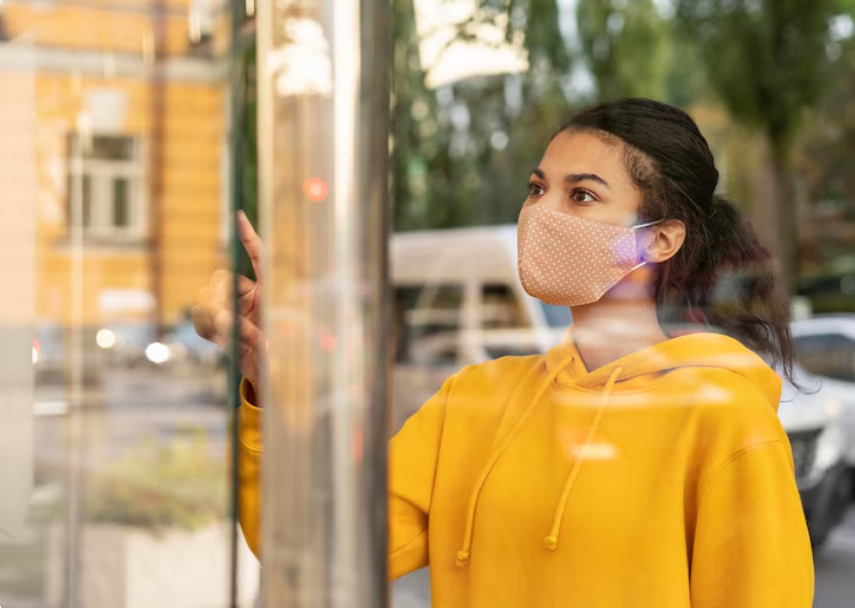
- Masks and Oversized Eyewear: Standard surgical masks combined with large sunglasses can obscure enough facial landmarks (the bridge of the nose, jawline, and cheekbones) to lower the confidence score of a facial recognition match, often rendering it unusable.
- Adversarial Patterns: Designers and privacy advocates have developed clothing and accessories featuring “adversarial patterns.” These prints are designed to confuse AI algorithms by presenting shapes that the software misinterprets as multiple overlapping faces, distracting the system from the wearer’s actual face.
- Infrared Disruptors: Some advanced privacy glasses incorporate infrared LEDs that are invisible to the human eye but appear as blindingly bright light to security cameras, effectively washing out the faceprint in the captured footage.
The Hidden Ecosystem: Data Brokers and Biometric Sharing
A common misconception is that a retailer keeps biometric data isolated within its own security systems. In reality, retail data is often a single node in a massive, interconnected data economy. Retailers frequently partner with third-party security vendors who supply the facial recognition watchlists.
When a store scans a face, that image may be cross-referenced against a national or global database managed by these third-party vendors. If a shopper is misidentified by a flawed algorithm in one store, that inaccurate profile can be propagated to hundreds of other stores using the same vendor. Advocacy groups like Privacy International consistently highlight how this unfettered sharing of biometric data creates invisible blacklists that consumers cannot see, challenge, or escape.
Taking steps to remove personal information from data brokers is a critical part of biometric protection. Comprehensive guides published by Consumer Reports emphasize that protecting privacy requires a proactive effort to scrub personal profiles from the public web, reducing the baseline imagery that these systems use to identify individuals.
Evaluating Privacy-Enhancing Strategies: A Comparative Analysis
To determine the best approach for protecting personal biometrics, consumers must weigh the effectiveness of different strategies against the effort required to implement them.
| Privacy Strategy | Description | Effectiveness | Effort Required | Retailer Compliance |
| Legal Deletion Requests (DSAR) | Submitting formal requests to delete stored faceprints. | High (in regulated areas) | Moderate | Legally Mandated (varies by state/country) |
| Digital Hygiene | Revoking app camera permissions and opting out of data sharing. | Moderate | Low | Voluntary / Regulatory |
| Financial Anonymity | Paying with cash to prevent identity-to-face linking. | High | Low | Not Applicable (Requires no compliance) |
| Physical Obfuscation | Wearing masks, large glasses, or adversarial fashion. | Variable (depends on algorithm) | Low to Moderate | Not Applicable (Bypasses system) |
| Data Broker Opt-Outs | Removing profile photos from third-party databases. | Moderate | High | Voluntary / Mandated by state law |
Frequently Asked Questions (FAQ)
Can a retailer scan my face without my explicit permission?
In most parts of the world, including the majority of the United States, retailers can legally scan faces without explicit, individual permission, provided they place a generalized warning sign at the store entrance. However, in jurisdictions with strict biometric laws like Illinois (BIPA) or the European Union (GDPR), explicit, opt-in consent is legally required before a biometric scan can take place.
How long do stores keep biometric data?
Data retention policies vary wildly. Some retailers purge faceprints immediately if no match is found against a loss-prevention database. Others may store the data for years to build long-term consumer behavior models. Reviewing a retailer’s specific privacy policy is the only way to determine their retention schedule.
Does wearing a standard medical mask stop facial recognition?
While masks initially caused major disruptions to facial recognition systems, developers have since trained their algorithms to focus heavily on the periocular region (the eyes and eyebrows). A standard mask alone is no longer a guaranteed defense against advanced tracking. Combining a mask with large sunglasses offers a significantly higher level of obfuscation.
Can I request the deletion of my biometric data if I live in a state without privacy laws?
Yes, but the retailer is not legally obligated to comply. However, many national retailers apply standard privacy practices across all their operations. Submitting a polite but firm deletion request to their privacy officer or customer service department often yields results, even in unregulated states.
Are there technological solutions to protect my biometrics online?
Yes. Using privacy-focused browsers, utilizing anti-tracking software, and carefully managing social media privacy settings (where algorithms scrape public photos to build facial recognition databases) are vital steps. The Electronic Frontier Foundation provides extensive resources on digital tools that help block online biometric tracking.
Conclusion: Reclaiming Your Biometric Sovereignty
The deployment of facial recognition in retail environments represents a fundamental shift in how personal data is collected in public spaces. Unlike a credit card number or an email address, a face cannot be easily changed if a database is breached or data is misused. The permanence of biometric markers makes their protection an urgent priority for modern consumers.
Completely opting out of this ecosystem is not a single action, but a continuous commitment to privacy awareness. It requires reading the fine print of store policies, understanding the rights granted by local legislation, actively managing digital footprints, and occasionally relying on physical countermeasures to disrupt unwanted surveillance. By combining legal knowledge with practical data hygiene and mindful consumer behavior, individuals can navigate the modern retail landscape without surrendering their most fundamental personal identifiers. Protecting biometric data ensures that the convenience of modern technology does not come at the cost of personal autonomy and foundational privacy rights.