

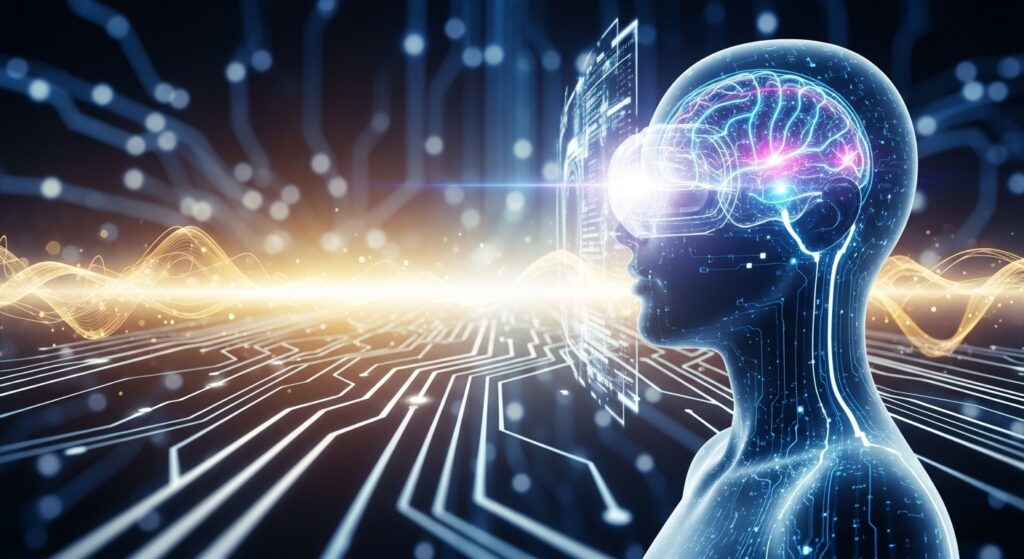
Imagine waking up tomorrow and realizing you no longer need to type an email, swipe through a news feed, or even speak to ask a question. Instead, you simply think about the message you want to send, and it appears on your screen instantly. You recall a forgotten memory with the clarity of a high-definition video, or you learn a new language by downloading the vocabulary directly into your neural pathways. For decades, this scenario was the exclusive domain of science fiction novels and blockbuster movies, a distant fantasy reserved for cyborgs and futuristic utopias. However, the line between that fiction and our reality is blurring faster than most people realize. We are standing on the precipice of a technological revolution known as the Brain-Computer Interface, or BCI, a field that promises to merge human cognition with digital intelligence. The question is no longer if this technology will mature, but rather how quickly it will reshape the very definition of what it means to be human and whether we are inadvertently building the infrastructure for a literal neural internet.
The concept of connecting the human brain to external devices is not entirely new, yet recent breakthroughs have accelerated the timeline from theoretical possibility to tangible application. At its core, a Brain-Computer Interface is a direct communication pathway between the brain’s electrical activity and an external device, such as a computer, robotic limb, or software application. Unlike traditional input methods like keyboards, mice, or voice commands, which rely on peripheral muscles and nerves, BCIs bypass these biological bottlenecks entirely. They interpret the electrochemical signals generated by neurons and translate them into digital commands. This shift represents a fundamental change in human-computer interaction, moving us from physical manipulation of tools to a seamless integration of thought and action. As researchers decode the complex language of the brain with increasing precision, we are beginning to see prototypes that allow paralyzed individuals to control cursors, type sentences at remarkable speeds, and even feel sensations through robotic hands. These are not just medical miracles; they are the foundational steps toward a future where the bandwidth between our minds and machines expands exponentially, potentially leading to an era where our thoughts are interconnected in a vast, digital network.
Decoding the Language of Neurons: How Brain-Computer Interfaces Actually Work
To truly understand the potential of the neural internet era, one must first grasp the intricate mechanics of how these interfaces capture and interpret the chaotic symphony of the human brain. The human brain contains approximately eighty-six billion neurons, each connected to thousands of others, creating a dynamic web of electrical impulses that govern everything from breathing to abstract philosophy. When a neuron fires, it generates a small voltage spike known as an action potential. A Brain-Computer Interface functions by detecting these spikes, filtering out the noise, and decoding the patterns to determine the user’s intent. This process is akin to listening to a stadium full of people shouting simultaneously and trying to isolate a single conversation to understand a specific command. The complexity lies in the fact that neural signals are not uniform; they vary based on attention, emotion, fatigue, and the specific task being performed.
There are primarily three categories of BCI technologies, distinguished by how close the sensors get to the neural tissue. Non-invasive BCIs, such as Electroencephalography (EEG) headsets, sit on the scalp and measure the aggregate electrical activity of large groups of neurons. While safe and easy to use, these devices suffer from signal degradation because the skull and skin act as insulators, muffling the high-frequency details of neural firing. Think of it as trying to hear a whisper from outside a thick concrete wall; you might catch the rhythm, but the nuances are lost. Despite this limitation, non-invasive systems have made significant strides in controlling simple devices, playing video games, and aiding in neurofeedback therapy for conditions like ADHD. They serve as the entry point for consumer-grade brain tech, offering a glimpse of what is possible without surgical intervention.
On the other end of the spectrum are invasive BCIs, which require neurosurgery to implant electrodes directly onto the surface of the brain or deep within the neural tissue. These devices, often referred to as intracortical implants, provide the highest resolution signals because they are in direct contact with the neurons. Companies like Neuralink and academic institutions like Stanford University have demonstrated that invasive arrays can decode complex motor intentions, allowing users to move computer cursors with sub-second latency or control robotic arms with multiple degrees of freedom. The trade-off, however, is the risk associated with surgery, including infection, scar tissue formation which can degrade signal quality over time, and the ethical implications of altering the brain’s physical structure. The precision of invasive systems is what makes the dream of a high-bandwidth neural internet feasible, as only high-fidelity data transmission can support the rich exchange of information required for true mind-to-machine integration.
Bridging the gap between these two extremes are semi-invasive or partially invasive techniques, such as Electrocorticography (ECoG), where electrodes are placed on the exposed surface of the brain but do not penetrate the tissue itself. This method offers a balance of signal clarity and safety, making it a popular choice for clinical applications like mapping brain function before epilepsy surgery or restoring speech in patients with locked-in syndrome. Recent studies have shown that ECoG grids can decode attempted speech with impressive accuracy, translating the neural patterns associated with forming words into text on a screen. This capability is crucial for the development of the neural internet, as language is the primary vehicle of human thought. If we can reliably translate internal monologue into digital text without vocalization, we have effectively created a new input modality that could render keyboards obsolete. The engineering challenge now shifts from mere detection to interpretation, requiring advanced machine learning algorithms that can adapt to the unique neural signature of each individual user.
From Medical Miracle to Consumer Reality: The Current State of BCI Technology
While the prospect of a neural internet captures the imagination, the current landscape of Brain-Computer Interface technology is firmly rooted in solving urgent medical challenges. The most profound successes of BCI thus far have been in restoring autonomy to individuals with severe neurological disorders. For patients suffering from amyotrophic lateral sclerosis (ALS), spinal cord injuries, or stroke-induced paralysis, BCIs offer a lifeline that transcends traditional assistive technologies. In landmark cases, individuals who have been completely unable to move or speak for years have regained the ability to communicate with loved ones, browse the internet, and control their home environments using only their thoughts. These achievements are not merely technical demonstrations; they represent a restoration of human dignity and agency. The technology has evolved from allowing users to select letters on a screen one by one to enabling fluid, conversational typing speeds that approach those of able-bodied individuals using smartphones.
Beyond motor restoration, researchers are making incredible progress in sensory restoration through bidirectional BCIs. Traditional interfaces only read signals from the brain, but bidirectional systems can also write information back into the nervous system. This capability has allowed blind individuals to perceive patterns of light through cameras connected to visual cortex implants, and amputees to feel texture and pressure through prosthetic limbs. By stimulating specific neurons, the brain interprets these electrical pulses as genuine sensory experiences, closing the loop between action and perception. This feedback mechanism is essential for fine motor control; without the sense of touch, gripping an egg without crushing it would be nearly impossible. The success of these sensory loops suggests that the brain is remarkably plastic, capable of integrating artificial inputs as if they were natural biological signals. This adaptability is the cornerstone upon which the future neural internet will be built, proving that the human mind can accept and process digital data streams as part of its own cognitive framework.
As the medical applications mature, the focus is slowly shifting toward consumer and enhancement applications, though this transition is fraught with caution. Tech giants and startups alike are investing billions into miniaturizing hardware, improving battery life, and developing wireless solutions that eliminate the tether of external cables. The vision is a discreet, perhaps invisible, device that enhances cognitive performance for the average person. Imagine a world where you can instantly access the sum of human knowledge, perform complex calculations in your head, or communicate telepathically with colleagues during a meeting. While we are not there yet, the trajectory is clear. Early consumer applications may likely focus on wellness and productivity, such as monitoring stress levels in real-time to optimize work schedules, enhancing focus through neurofeedback, or controlling smart home ecosystems with a glance or a thought. The barrier to entry is lowering, but the leap from medical necessity to lifestyle enhancement requires a level of reliability, safety, and social acceptance that has not yet been fully achieved.
The ecosystem surrounding BCI is also expanding rapidly, with open-source initiatives and collaborative research accelerating innovation. Universities, hospitals, and private corporations are sharing datasets and algorithms to improve decoding models. This collaboration is vital because the variability in human brain anatomy means that a “one-size-fits-all” solution is unlikely. Personalized calibration, where the AI learns the specific neural patterns of an individual user over time, is becoming the standard. Furthermore, the software layer is becoming just as important as the hardware. Just as the iPhone needed the App Store to become revolutionary, BCIs need a robust software ecosystem that allows developers to create applications leveraging neural data. We are beginning to see the emergence of platforms that enable third-party developers to build games, productivity tools, and therapeutic apps designed specifically for brain-control, signaling the early stages of a new computing paradigm.
The Vision of a Neural Internet: Connecting Minds in a Digital Web
When we speak of the “Neural Internet,” we are describing a hypothetical future infrastructure where human brains are directly connected to a global digital network, facilitating the direct exchange of thoughts, emotions, and sensory experiences. This concept goes far beyond today’s internet, which acts as an external repository of information that we access through limited bandwidth channels like eyes and fingers. In a neural internet era, the distinction between internal memory and external storage could vanish. Information would not need to be searched for and consumed; it could be recalled or experienced as if it were a native thought. This shift would fundamentally alter human collaboration, education, and empathy. Instead of struggling to articulate a complex idea through imperfect language, individuals could share the raw conceptual framework of their thoughts, reducing misunderstanding and accelerating innovation.
The architecture of such a network would rely on ultra-high-bandwidth BCIs capable of transmitting massive amounts of data in real-time. Current invasive implants can handle dozens to hundreds of channels of data, but a true neural internet would likely require millions of simultaneous connections to capture the richness of human consciousness. This would necessitate breakthroughs in nanotechnology, wireless power transmission, and biocompatible materials that can interface with the brain indefinitely without causing immune responses. The role of artificial intelligence in this scenario cannot be overstated; AI would act as the translator and router, compressing complex neural patterns into transmittable data packets and decompressing them at the receiving end to stimulate the corresponding neural pathways in another brain. This AI-mediated translation would ensure that the recipient understands the sender’s intent, context, and emotional tone, preserving the nuance that is often lost in textual or verbal communication.
One of the most compelling arguments for the neural internet is the potential for collective intelligence. If humans could link their cognitive processes, we could solve problems that are currently beyond the reach of any single individual or even large teams. Complex scientific modeling, climate change strategies, and global logistical challenges could be tackled by a distributed network of minds working in synchrony. This form of collaboration would transcend language barriers and cultural differences, creating a truly global consciousness. Education would be transformed from a process of gradual accumulation to one of instant acquisition. Learning a new skill, such as playing the piano or speaking Mandarin, could involve downloading the necessary neural patterns and muscle memory protocols directly, allowing the learner to practice and refine rather than start from zero. While this sounds like magic, it is a logical extension of the trajectory we are currently on with memory prosthesis research and skill acquisition studies in animal models.
However, the realization of a neural internet also raises profound questions about identity and individuality. If thoughts can be shared directly, where does one person end and another begin? The boundaries of the self, which are currently defined by the privacy of our internal monologue, would become porous. This could lead to a new form of social existence where empathy is not an exercise in imagination but a direct sensory experience. Feeling the pain or joy of another person as vividly as your own could eradicate conflict and foster unprecedented levels of cooperation. Yet, it could also lead to a loss of personal autonomy if the network exerts influence over individual thought processes. The design of such a system would need to include robust safeguards to ensure that connectivity does not equate to control, preserving the sanctity of the individual mind while enabling the benefits of connection.
Navigating the Ethical Minefield: Privacy, Security, and Human Autonomy
As we march toward the neural internet era, the ethical implications of Brain-Computer Interfaces demand immediate and rigorous attention. The stakes are higher than any previous technological revolution because BCIs interact directly with the source of human identity: the mind. The concept of “neurorights” has emerged in legal and philosophical discourse to address these unique challenges. Chief among these concerns is cognitive liberty, the right to self-determination over one’s own mental processes. If a device can read your thoughts, who owns that data? Could employers mandate BCI usage to monitor employee focus or honesty? Could insurance companies adjust premiums based on neural markers of stress or predisposition to certain behaviors? The potential for surveillance and coercion is immense, and without strong regulatory frameworks, we risk entering a dystopia where mental privacy is a luxury of the past.
Data security takes on a terrifying new dimension in the context of BCIs. Traditional cybersecurity breaches involve stolen credit card numbers or leaked emails; a breach of a neural interface could involve the theft of intimate memories, the manipulation of emotions, or the injection of false sensory experiences. The term “brain hacking” is no longer purely speculative. If a malicious actor gains access to a bidirectional BCI, they could theoretically alter a user’s perception of reality, induce panic, or even override motor controls. Ensuring the integrity of these systems requires encryption standards far beyond what is currently used in banking or defense. The hardware itself must be designed with security as a primary feature, not an afterthought, incorporating fail-safes that prevent unauthorized writing to the brain. The psychological impact of knowing one’s mind is vulnerable to external intrusion could be debilitating, potentially causing widespread anxiety and resistance to adopting these life-changing technologies.
Another critical ethical frontier is the issue of equity and the digital divide. Advanced BCIs, especially invasive ones, are likely to be expensive initially, creating a scenario where only the wealthy can afford cognitive enhancements. This could lead to a biological caste system, where the enhanced possess superior memory, processing speed, and communication abilities, leaving the unenhanced behind in the workforce and society. The gap between the “neuro-rich” and the “neuro-poor” could widen existing social inequalities to an unbridgeable chasm. Furthermore, there is the question of consent and agency. For individuals with severe disabilities, the desire to regain function may pressure them to accept risks they would otherwise reject. For healthy consumers, the subtle pressure to enhance performance to remain competitive could erode the freedom to remain unmodified. Society must grapple with whether cognitive enhancement should be treated as a medical right, a consumer choice, or a regulated privilege.
The long-term effects on human psychology and social dynamics are also unknown. Constant connectivity to a neural network could alter the way we process solitude, reflection, and creativity. Many great ideas emerge from the quiet spaces of the mind, free from external input. If those spaces are perpetually filled with the noise of the network, we may lose the capacity for deep, independent thought. Additionally, the authenticity of human relationships could be challenged. If we can simulate emotions or share curated thoughts directly, do we lose the value of genuine, imperfect human interaction? There is a risk that the ease of digital empathy could replace the hard work of understanding others in the physical world. Addressing these concerns requires a multidisciplinary approach involving neuroscientists, ethicists, policymakers, and the public to establish guidelines that prioritize human well-being over technological acceleration.
Practical Steps for Engagement: How to Prepare for the Neural Future
While the full realization of the neural internet may be years or even decades away, there are practical steps individuals, professionals, and organizations can take today to prepare for this impending shift. For the general public, the first step is education and awareness. Understanding the basics of neuroscience, the capabilities of current BCI technology, and the associated ethical debates empowers you to make informed decisions as these products enter the market. Engage with reputable sources, follow developments from leading research institutions, and participate in public discussions regarding neurorights and data privacy. Being an informed citizen is crucial because the regulations governing this technology will be shaped by public opinion and advocacy. Do not wait for the technology to arrive before considering your stance on mental privacy; define your boundaries now.
For professionals in technology, healthcare, and policy, the opportunity to shape the future is immediate. Software developers should begin exploring the APIs and SDKs released by BCI companies to understand how neural data is structured and processed. Building applications that respect user privacy and prioritize accessibility will set a precedent for the industry. Healthcare providers need to stay updated on the clinical applications of BCIs to better advise patients and integrate these tools into treatment plans. Policymakers and legal experts must work proactively to draft legislation that protects neurorights, establishes liability frameworks for neural data breaches, and ensures equitable access to enhancement technologies. The window to establish these guardrails is open now, while the technology is still in its developmental stages, but it will close quickly once mass adoption begins.
Investors and business leaders should look beyond the hype and identify sustainable use cases that deliver genuine value. Rather than chasing speculative bubbles, focus on sectors where BCIs solve clear, pressing problems, such as rehabilitation, mental health monitoring, and specialized industrial control. Due diligence should include a thorough assessment of the ethical implications and long-term viability of the technology. Companies that embed ethical principles into their product design from day one will build the trust necessary for widespread adoption. Furthermore, fostering a culture of interdisciplinary collaboration is essential. The challenges of the neural internet cannot be solved by engineers alone; they require insights from psychologists, sociologists, philosophers, and artists to ensure the technology serves humanity holistically.
On a personal level, you can experiment with existing non-invasive BCI devices to familiarize yourself with the experience of brain-controlled interaction. Several consumer-grade headsets are available for meditation training, focus enhancement, and gaming. While these devices are limited compared to clinical implants, they offer a tangible introduction to the concept of neurofeedback and help demystify the technology. Pay attention to how your brain responds to real-time feedback and consider the implications of having your mental states quantified. This hands-on experience can provide valuable perspective on the balance between utility and intrusion. Additionally, cultivate habits of digital hygiene and mental discipline. As our lives become more integrated with technology, the ability to disconnect and engage in deep, uninterrupted thought will become an increasingly valuable skill. Protecting your cognitive space today prepares you for a future where that space may be contested.
Common Misconceptions and Clarifying the Hype
Despite the rapid advancements in Brain-Computer Interfaces, several misconceptions cloud public understanding, often fueled by sensationalist media coverage and science fiction tropes. One prevalent myth is that BCIs can already read specific thoughts or memories like a movie reel. In reality, current technology is far from decoding the rich, semantic content of human thought. Most successful decoders rely on pattern recognition associated with specific tasks, such as imagining moving a hand or focusing on a particular letter. They do not eavesdrop on your internal monologue or retrieve random memories unless you are actively attempting to recall them in a controlled setting. The complexity of semantic meaning involves distributed networks across the entire brain, and we are only beginning to scratch the surface of how to interpret these patterns. It is crucial to distinguish between detecting intent and reading minds; the former is a measurable engineering challenge, while the latter remains largely theoretical.
Another common misunderstanding is the belief that invasive BCIs are ready for widespread consumer use. While clinical trials have shown remarkable results, invasive procedures still carry significant risks and are currently reserved for patients with severe disabilities where the benefit outweighs the danger. The idea that you will be able to walk into a clinic next year and get a chip implanted to boost your memory or download skills is unrealistic. The regulatory hurdles, safety concerns, and technical limitations regarding long-term stability mean that consumer invasive BCIs are likely a distant future scenario. Non-invasive options are the immediate future for the general public, but they come with their own limitations in terms of signal quality and bandwidth. Managing expectations is vital to avoid disappointment and to ensure that the technology is adopted responsibly as it matures.
There is also a fear that BCIs will inevitably lead to the loss of free will or total control by external entities. While the risks of manipulation are real and must be mitigated through security and regulation, the narrative of inevitable enslavement ignores the agency inherent in the design and deployment of these tools. Humans have always adapted to new technologies, from the printing press to the smartphone, finding ways to harness them for empowerment while developing social norms and laws to prevent abuse. BCIs are tools, not masters. Their impact depends entirely on how we choose to build, regulate, and use them. The conversation should not be dominated by fatalism but by proactive stewardship. By acknowledging the risks without succumbing to panic, we can foster an environment where innovation thrives alongside robust ethical safeguards.
Finally, many assume that the neural internet will replace human interaction rather than enhance it. The vision of a connected mind does not necessitate the erosion of physical presence or face-to-face communication. Instead, it offers a new layer of interaction that can complement existing modes of connection. Just as video calling did not replace phone calls but added a new dimension to remote communication, neural connectivity could add depth and efficiency to how we share ideas and emotions. The goal of the technology should be to augment human capability, not to substitute the essence of the human experience. Recognizing this distinction helps frame the discussion around enhancement and collaboration rather than replacement and obsolescence.
The Road Ahead: Balancing Innovation with Humanity
As we stand on the threshold of the neural internet era, the path forward is illuminated by both extraordinary promise and profound responsibility. Brain-Computer Interfaces represent one of the most significant leaps in human evolution, offering the potential to heal the broken, empower the disabled, and expand the horizons of human cognition. The ability to merge our biological intelligence with digital systems could unlock solutions to problems that have plagued us for centuries, fostering a new age of creativity, empathy, and collective achievement. However, this power comes with the obligation to proceed with caution, ensuring that the technology serves the best interests of all humanity rather than a select few. The decisions we make today regarding privacy, security, and ethics will echo through generations, shaping the very fabric of future society.
The journey toward a fully realized neural internet will not be linear. It will be marked by iterative breakthroughs, regulatory debates, and societal adjustments. There will be setbacks and controversies, but these are natural parts of the growth process for any transformative technology. What matters is maintaining a commitment to transparency, inclusivity, and human-centric design. We must ensure that the benefits of BCIs are accessible to everyone, regardless of socioeconomic status, and that the rights of the individual mind are protected against exploitation. By fostering a dialogue that includes diverse voices from across the globe, we can navigate the complexities of this new frontier with wisdom and foresight.
Ultimately, the question of whether we are entering the neural internet era is not just about technological capability; it is about human choice. We have the tools to build this future, but we also have the agency to define what that future looks like. Will it be a world of enhanced connection and understanding, or one of surveillance and division? The answer lies in our hands, or rather, in our minds. As we continue to explore the depths of the brain and the heights of digital integration, let us remain grounded in our shared humanity. Let us strive to create a neural internet that amplifies the best of who we are, preserving the dignity, autonomy, and wonder of the human spirit in an increasingly connected world. The adventure has just begun, and every one of us has a role to play in writing the next chapter of our story.